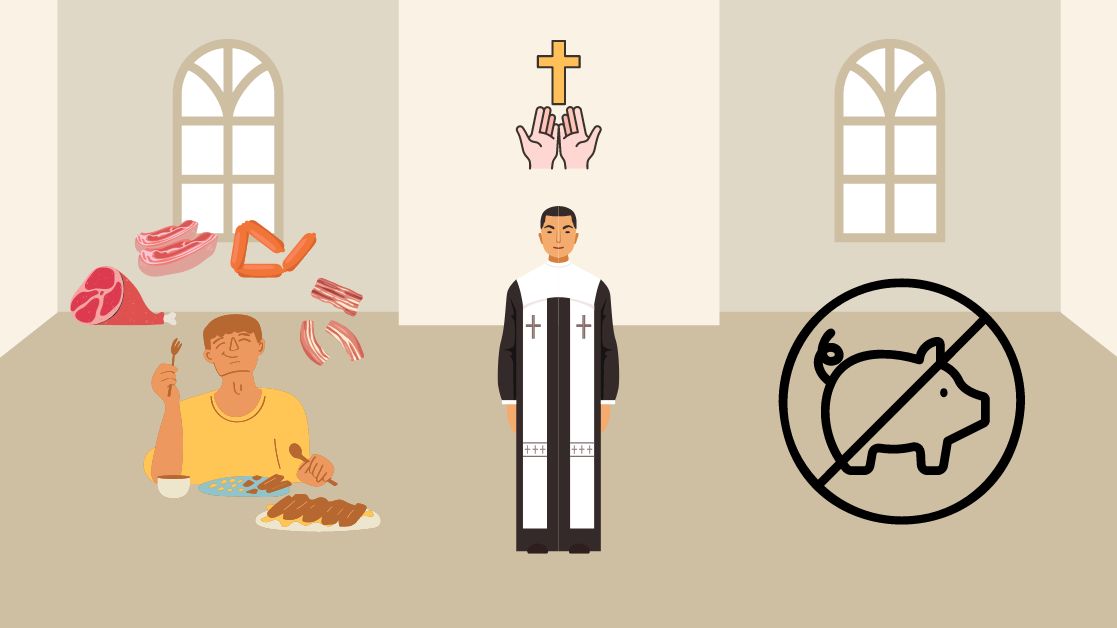
Short answer: No, eating pork is not a sin for Christians. The law of Moses forbade pork to Israel, but Jesus declared all foods clean, God showed Peter in a vision that he should not call anything impure that God has made clean, and Paul taught that no food is unclean in itself. A Christian may eat pork with thanksgiving while respecting a brother or sister who chooses not to.
In This Article
Pork is one of those subjects where a Bible reader can feel caught between two parts of Scripture. Leviticus plainly calls the pig unclean. The Gospels and Acts plainly say that Christians may eat what they like. Both are in the Bible, and both are true, once you see how the story fits together.
I want to show the logic step by step, because the principle at work here applies to a good deal more than pork.
Why Did Leviticus Ban Pork?
The pig appears in the food laws God gave to Israel through Moses. The text names the reason in terms of anatomy.
And the pig, though it has a divided hoof, does not chew the cud; it is unclean for you.Leviticus 11:7 (NIV)
The same rule is repeated in Deuteronomy 14:8, and the law lists many other animals as unclean, including camels, rabbits, shellfish and certain birds.
Why? The Bible does not give a single stated reason. Some people suggest health, since pork could carry parasites if undercooked, and that may have been a side benefit. Others point to the pigs' association with pagan worship in neighboring cultures. But the clearest purpose the Bible itself gives is holiness and separation.
The Lord said to Israel that they were to be holy because he is holy, and that he had set them apart from the nations (Leviticus 20:24-26). The food laws made Israel's identity visible at every meal. Eating the right things was a daily reminder that they belonged to the Lord. It was a sign, not a medical program.
The important thing to see is that these laws belonged to the covenant God made with Israel at Sinai. They were never given to the nations as a whole, and Gentiles before Moses, such as Noah's family after the flood, were told they could eat every living thing (Genesis 9:3).
What Did Jesus Say In Mark 7:19?
Jesus addressed the question head on. The Pharisees had criticized his disciples for eating without ceremonial washing, and Jesus turned the conversation to what truly defiles a person.
He told the crowd that nothing outside a person can make them unclean by going in, and that what comes out of the heart is what defiles. Then, when his disciples asked him about it privately, he explained that food does not enter the heart but the stomach and passes out of the body. And Mark adds a comment of his own:
In saying this, Jesus declared all foods clean.Mark 7:19 (NIV)
Mark was writing to explain Jesus's meaning to a mostly Gentile audience, and he did not hold back. In the plain reading, Jesus set aside the distinction between clean and unclean foods that had marked Israel's table. See also the whole passage in Mark 7:14-23, and Jesus's teaching on the same point in Matthew 15:10-20.
He did not come to throw out God's Word. He came to fulfil it (Matthew 5:17). The food laws pointed to a deeper cleanness, one of the heart, and Jesus brought that in. For related thinking, see our article on eating meat.
What Did Peter's Vision In Acts 10 Mean?
Years after the resurrection, Peter was still keeping the Jewish food laws. Then God gave him a vision of a sheet full of animals, clean and unclean, and a voice told him to kill and eat. Peter protested that he had never eaten anything impure or unclean. The voice answered:
Do not call anything impure that God has made clean.Acts 10:15 (NIV)
This happened three times (Acts 10:9-16). Peter was puzzled, and then the meaning arrived: men sent by a Roman centurion named Cornelius were at the door. The vision was about food, but its real consequence was about people. God was telling Peter that Gentiles were not unclean either, and that he could go into their home, eat with them, and share the gospel. Peter later told the Jerusalem council what had happened, and the early church agreed that Gentile believers did not have to keep the law of Moses (Acts 15:1-21).
The council did ask Gentile believers to avoid food sacrificed to idols and blood, but it did not mention pork, and it did not put them under Leviticus. Paul's letters then make the same point repeatedly. He says in 1 Timothy 4:4 that everything God created is good, and in Romans 14:14 that nothing is unclean in itself. Colossians 2:16-17 tells believers not to let anyone judge them over what they eat or drink. The food laws, he says, were a shadow, and the reality is found in Christ.
So the answer to "can a Christian eat pork?" is yes, and the Bible gives that answer in the Gospels, Acts and the letters of Paul.
Do Any Christians Still Avoid Pork?
Yes, and the Bible has advice for how to treat them. Some Christians, including Seventh-day Adventists and some Messianic believers, keep the dietary laws or avoid pork as a matter of conviction or health. Some do it because of their Jewish heritage. Others avoid it for health reasons or cultural ones.
Paul addressed exactly this kind of disagreement in Romans 14. He said the believer who eats all things should not look down on the one who does not, and the believer who abstains should not condemn the one who eats.
For the kingdom of God is not a matter of eating and drinking, but of righteousness, peace and joy in the Holy Spirit.Romans 14:17 (NIV)
The practical rule is love. If you are eating with someone who abstains from pork and would be troubled by seeing you eat it, you can choose to eat something else out of love for them (Romans 14:20-21, 1 Corinthians 8:13). That is not because pork is sinful, but because your neighbor matters more than your plate. Related: see what the Bible says about causing others to stumble.
Some people ask about the first Christians and when they began eating pork. The New Testament record shows that the question was settled in the first generation, as Gentile believers joined the church without taking on Jewish dietary law. There was no single moment, but the apostolic teaching is clear.
A Note On Health
Some cuts of pork are high in saturated fat, and processed pork such as bacon and sausage is something doctors advise us to eat in moderation. That is simply good stewardship of the body, and it applies to many foods. It is a matter of wisdom, not of sin, and it connects to self-control, which we discuss in is gluttony a sin.
Above all, remember that no diet saves us. We are saved by grace through faith in Christ alone, not by what we eat or avoid. Pork is a good thing to receive with thanks.
Key Bible Verses About Eating Pork
- Leviticus 11:7: The pig was unclean for Israel under the law of Moses.
- Mark 7:18-19: Jesus declares all foods clean.
- Acts 10:13-15: God tells Peter not to call anything impure that he has made clean.
- Romans 14:14: Nothing is unclean in itself.
- Romans 14:17: The kingdom of God is not eating and drinking but righteousness, peace and joy.
- 1 Timothy 4:4: Everything God created is good when received with thanksgiving.
- Colossians 2:16-17: Do not let anyone judge you by what you eat or drink.
Frequently Asked Questions
Does God forbid you to eat pork?
God forbade pork to Israel under the law of Moses, but that law was a temporary covenant for his people before Christ. In the New Testament, Jesus declared all foods clean, and Peter was told not to call anything impure that God has made clean. Christians are not bound by the Old Testament food laws.
What does the Bible say about bacon?
Nothing by name, since bacon is simply cured pork. It falls under the same teaching as any other pork: forbidden to Israel in Leviticus 11 and Deuteronomy 14, and permitted to Christians in the New Testament. Enjoy it with thanks, and use the self-control Scripture asks for in all eating.
What meats did God say not to eat?
Leviticus 11 and Deuteronomy 14 forbid animals that do not both have a divided hoof and chew the cud, including pigs, along with camels, rabbits, shellfish and certain birds and insects. These were laws for Israel, and Christians are not under them.
Did Peter eat pork?
The Bible does not say that Peter ate pork. It does say that God showed him in a vision that no food was to be called unclean, and that he then went into a Gentile home and ate with them. Acts 10 and Galatians 2 show that he was learning what the new freedom meant.
Why do some Christians still avoid pork?
Some, such as Seventh-day Adventists and certain Messianic believers, hold that the Old Testament dietary laws still apply or are wise to keep. Others avoid it for health or cultural reasons. Romans 14 teaches that these differences are matters of conscience, not reasons to divide.