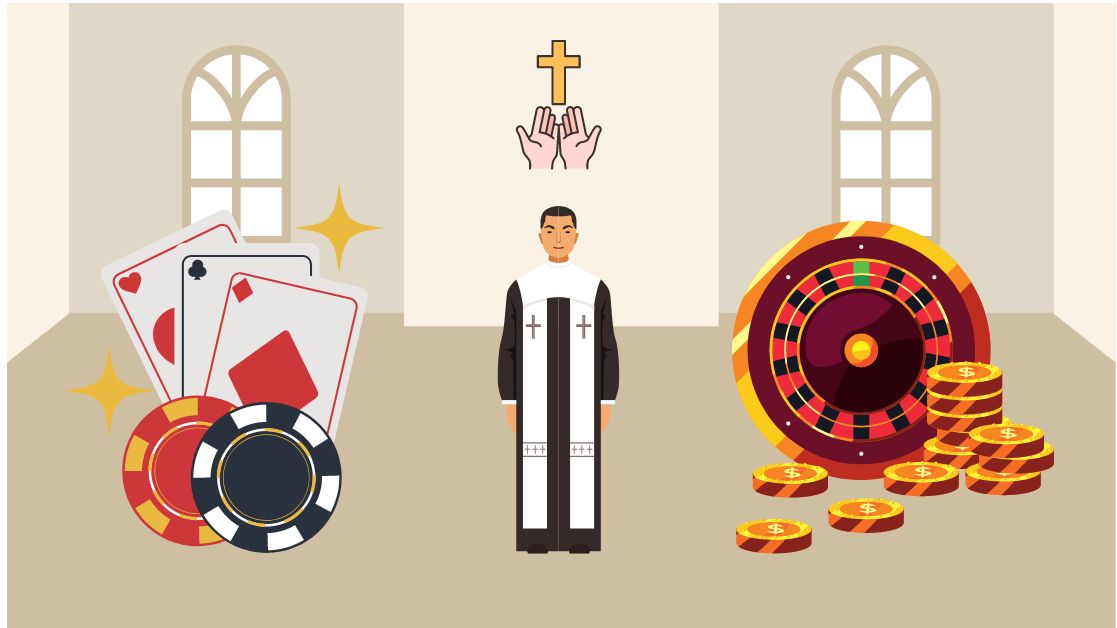
Short answer: The Bible never mentions gambling by name, so it does not say outright that gambling is a sin. It does warn firmly against greed, the love of money, get-rich-quick schemes and being mastered by anything other than God. Because gambling so often feeds those very things, many Christians avoid it entirely. My own view is that if you are prone to greed or compulsion you should stay away, while a small, controlled bet for fun is a matter of conscience and not a clear sin.
In This Article
Few questions about money divide churches quite like this one. Some believers will not even buy a raffle ticket, and others cheerfully join the office pool. Both groups usually quote the Bible, and both think the other has missed something. People in the pews kept asking me where Scripture actually lands, so let us go through it carefully, without adding rules that God has not given.
We will look at what the Bible says and does not say, why so many Christians land on the cautious side, how to think about lotteries and casual bets, and what to do if gambling has taken hold of you or someone you love.
Does The Bible Mention Gambling?
Not directly. There is no verse saying "you shall not gamble," in the way that there is a verse about stealing or murder. Casinos, slot machines and sports betting did not exist in Bible times, and the Scriptures do not address them as such. That silence should keep us honest: we must not claim "thus says the Lord" where He has not spoken.
There are, however, a few things in the Bible that are close relatives. People in the Old Testament cast lots to make decisions, and Proverbs speaks about it:
The lot is cast into the lap, but its every decision is from the Lord.
Proverbs 16:33 (NIV)
The apostles used the same method when they chose a replacement for Judas (Acts 1:26), and the soldiers at the cross cast lots for Jesus' clothing (John 19:24). But notice that casting lots to make a decision, with prayer and trust in God's sovereignty, is not the same thing as staking your money for the chance of profit. I do not think we can build a defence of the casino on these verses.
What the Bible gives us, instead, are principles. Let us look at those.
Why Do Many Christians Call Gambling Sinful?
The reasoning is built on principles that run all through Scripture. I find four of them worth taking seriously.
1. Gambling Feeds The Love Of Money
Most people gamble hoping to leave with more than they brought. That hope for easy wealth is exactly what Paul warns about:
For the love of money is a root of all kinds of evil. Some people, eager for money, have wandered from the faith and pierced themselves with many griefs.
1 Timothy 6:10 (NIV)
Notice that Paul does not say money is evil. He says the love of it is a root of many evils. Hebrews adds a positive instruction, which is contentment. For more on this, see our article on whether greed is a sin.
2. Gambling Promises Quick Riches
Proverbs offers a plain contrast between sudden gain and steady work:
Dishonest money dwindles away, but whoever gathers money little by little makes it grow.
Proverbs 13:11 (NIV)
Gambling businesses are built on the plain mathematical reality that, over time, the house wins. A person who bets regularly is not weighing risk by logic, but often by hope, superstition and the feeling that a win is due. Scripture's approach to wealth is wiser: honest labour, fair exchange and gifts. Scripture condemns getting ahead by cheating, stealing or lying.
3. Gambling Can Master Us
Jesus said we cannot serve two masters:
No one can serve two masters. Either you will hate the one and love the other, or you will be devoted to the one and despise the other. You cannot serve both God and money.
Matthew 6:24 (NIV)
Compulsive gamblers lose control of their time, their savings and their relationships, much as people do with alcohol or drugs. Self-control is a fruit of the Spirit (Galatians 5:22-23), and anything that takes it from us has become a problem.
4. Gambling Can Treat Money Carelessly
Everything we have belongs to God (Psalm 24:1), and we are stewards who must give an account, as Jesus' parable of the talents shows (Matthew 25:14-30). Money wagered on a game of chance is money not used to provide for a family (1 Timothy 5:8), to give or to save. Jesus also warns about greed in the parable of the rich fool (Luke 12:13-21), a man who stored up wealth for himself and was not rich toward God.
Is Winning The Lottery A Blessing From God?
Wealth in Scripture is a mixed thing. It can be a gift from God and it can be a snare. A believer who wins a prize can thank God and use the money generously, and I would not call that sinful. But I would be wary of treating a win as a sign of God's favour. The Preacher in Ecclesiastes observed that money never satisfies the person who loves it:
Whoever loves money never has enough; whoever loves wealth is never satisfied with their income. This too is meaningless.
Ecclesiastes 5:10 (NIV)
There is also a quieter issue with lotteries: they are often paid for by people who can least afford a loss, and they promise hope that rarely arrives. That is a pastoral concern, not a verse. I have a longer treatment in Is Playing The Lottery A Sin?, and I would encourage you to read it if this is your particular question.
What About Casual Bets And Office Pools?
Here I want to be careful not to be harsher than the Bible. A friendly wager for a small sum, a church raffle or an office pool is not the same as a casino habit. Jesus' sharpest words are for greed and the love of money, not for every game with a prize.
If you are thinking it through, I would ask yourself these questions:
- Could I lose this money without harming my family or my giving?
- Am I doing it for fun, or hoping to get rich?
- Can I stop at once, without any struggle?
- Would I be at ease if my pastor or family knew exactly how much I bet?
- Could this cause a younger or weaker believer to stumble? Paul discusses this in Romans 14, where he asks us to consider the conscience of others.
If you can honestly answer in favour of all of these, I would say it is a matter of Christian freedom, but do not treat freedom as an excuse. If any answer troubles you, listen to that unease. Believers also disagree on this issue, and that is acceptable as long as we do not judge one another harshly (see our article on judging).
What If Gambling Has Become An Addiction?
If you cannot stop, hide your betting, borrow to cover losses or lie about it, then the question of whether gambling is a sin has already been answered for you. It has become a master. The good news is that the Bible does not leave you there. Repentance and forgiveness are real, and God's grace is bigger than a gambling debt. Our article on whether God forgives all sins explains it, and how to repent gives the steps.
Practically, I would encourage you to do five things:
- Tell God the whole truth, and then tell one trusted person.
- Remove the easy routes: delete the apps, close the accounts and give up the cards.
- Be open about debts, and ask someone to help you build a repayment plan.
- Contact a pastor, a counselor or a problem gambling helpline in your country.
- Stay in fellowship, because isolation is where this thrives.
Our article on addiction goes into the wider picture.
Key Bible Verses About Gambling And Money
- 1 Timothy 6:9-10: those who want to get rich fall into temptation and a trap.
- Proverbs 13:11: money gathered little by little grows.
- Hebrews 13:5: be content, because God will never leave you.
- Matthew 6:24: you cannot serve both God and money.
- Luke 12:15: life does not consist in an abundance of possessions.
- Ecclesiastes 5:10: whoever loves money never has enough.
- Proverbs 16:33: the lot is cast, but the decision is the Lord's.
Frequently Asked Questions
Is winning the lottery a blessing from God?
Scripture treats wealth as a gift from God that can also become a danger, so a windfall can be received with thanks and used well. But a big win is not proof of God's favour, and a loss is not proof of His displeasure. What counts is what you do with the money. For more on lotteries, see our article on playing the lottery.
Does Christianity allow you to gamble?
Christians disagree. Some hold that all gambling is wrong because it feeds greed and trusts chance over God. Others hold that occasional, low-stakes play for entertainment is no different from other recreation. The Bible gives no direct command, so each believer must test their own heart against its warnings about money.
Is buying a raffle ticket or joining an office pool a sin?
The Bible does not forbid it, and a small, friendly wager is a very different thing from a habit that drains the family budget. Ask whether you could lose the money without harm, whether you are doing it to get rich, and whether it troubles another believer's conscience.
How do I stop gambling when it has become a problem?
Admit it honestly to God and to a trusted person, remove easy access such as apps, accounts and cards, and seek help from a pastor, a counselor or a problem gambling helpline in your country. Compulsive gambling is rarely beaten alone. Our article on addiction may also help.
Is it a sin to gamble with money I can afford to lose?
Affording the loss answers the question of debt and family provision, but it does not settle the question of the heart. Ask why you are playing. If it is simple entertainment and you can walk away at once, that is one thing. If you are chasing a win or hiding the habit, that is another.