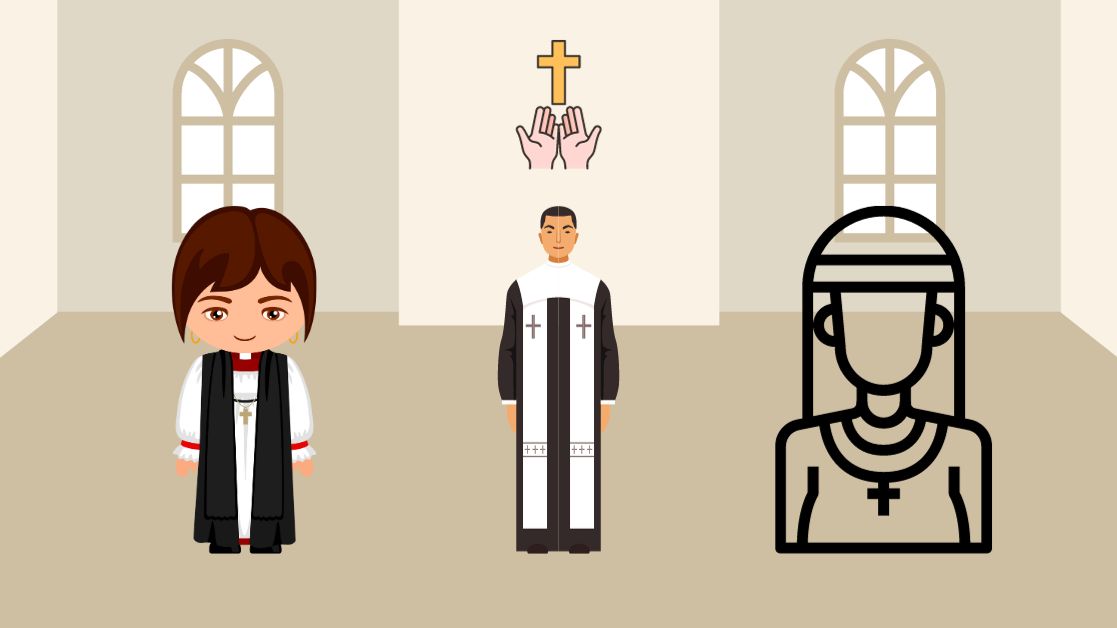
Short answer: Christians who love the Bible disagree about this, and I want to say so honestly. My reading is that Scripture reserves the office of pastor-elder, and the spiritual teaching authority that goes with it over the whole congregation, for qualified men, based chiefly on 1 Timothy 2:12 and the qualifications for elders. At the same time, the Bible shows women prophesying, teaching other women and children, leading in the Old Testament, serving as deacons and co-workers, and using every gift of the Spirit. This is not a question of worth. It is a question of how God structured church leadership.
In This Article
Few questions in the church stir up stronger feelings than this one, and I understand why. It touches on dignity, calling, and how we read the Bible. People in the pews kept asking me about it, sometimes out of real hurt, sometimes out of real puzzlement, and I always began by saying the same thing.
This is not a contest between men and women. It is not rooted in chauvinism or discrimination, and it should never be framed that way. It is a question about how to read certain passages of Scripture faithfully. Below I walk through the key text, the women of the Bible, the two main views, and how churches decide today.
What Does 1 Timothy 2:12 Say?
This is the verse most often cited, and it is the center of the debate.
I do not permit a woman to teach or to assume authority over a man; she must be quiet.
1 Timothy 2:12 (NIV)
Read together with 1 Timothy 2:11-12, many Christians through church history have understood Paul to be prohibiting women from serving as pastors and elders, and from exercising authoritative teaching over men in the gathered church. That is where I come down, and I will give my reasons.
- Paul grounds his instruction in creation (the order of Adam and Eve, verses 13 and 14), not only in the local culture of Ephesus.
- The qualifications for overseers in 1 Timothy 3 speak of the overseer as a husband, "faithful to his wife," and the pattern in Titus is the same.
- The role in question is authoritative teaching and oversight of the whole congregation, not every kind of speaking or service.
Now the overseer is to be above reproach, faithful to his wife, temperate, self-controlled, respectable, hospitable, able to teach
1 Timothy 3:2 (NIV)
Others read the passage differently. They argue that Paul was addressing specific problems in the Ephesian church, such as false teaching spreading through uninstructed teachers, and was not issuing a universal ban. They point to the difficult Greek word translated "assume authority" and note that it appears only here in the New Testament. These are serious arguments made by serious, Bible-loving people, and I do not wave them away. I simply find the creation-based reasoning, and the pattern of male elders, more persuasive.
Which Women Led In Scripture?
The Bible honors women, and anyone who says otherwise has not read it carefully. Women appear in leadership and ministry throughout.
In The Old Testament
Deborah is the clearest example of a woman in a position of authority.
Now Deborah, a prophet, the wife of Lappidoth, was leading Israel at that time.
Judges 4:4 (NIV)
Deborah served as a prophetess and a judge, and her leadership shows that God can use women in significant roles of authority. Miriam, Huldah and Esther are also remembered for their faithfulness. Anyone reading the Old Testament will meet these women. It is worth recognizing, though, that Israel's judges and prophets were not the same office as a pastor-elder in the New Testament church, so the question about pastors does not rest on these examples either way.
In The New Testament
- Phoebe was commended by Paul as a servant, or deacon, of the church in Cenchreae (Romans 16:1).
- Priscilla, with her husband Aquila, took Apollos aside and explained the way of God to him more accurately (Acts 18:26).
- The four daughters of Philip prophesied (Acts 21:9).
- Women prayed and prophesied in the gathered church (1 Corinthians 11:5).
- Older women are told to teach younger women (Titus 2:3-5).
A great deal of local-church ministry depends on women, in hospitality, compassion, teaching, evangelism, counseling and service. The Bible does not limit women in using the gifts of the Holy Spirit, as 1 Corinthians 12 makes clear. Women and men alike are called to bear the fruit of the Spirit (Galatians 5:22-23) and to take the gospel to people who have not heard it (Matthew 28:18-20; Acts 1:8; 1 Peter 3:15). The Bible places no restriction on women teaching children.
What Is The Complementarian View?
Complementarians believe that men and women are equal in worth, dignity and value before God, but are given distinct roles in the home and the church. In this view, the office of pastor or elder, with its authoritative teaching and oversight, is reserved for qualified men, while women are encouraged to use their gifts widely, including teaching women and children, leading ministries, counseling, and serving in many other ways.
The Southern Baptist Convention, the Presbyterian Church in America, the Lutheran Church-Missouri Synod, the Roman Catholic Church and the Orthodox churches all restrict the priesthood or pastoral office to men, though they hold this for different reasons. The Catholic and Orthodox position rests on the male priesthood as a matter of apostolic tradition, which is related to but not identical with the Protestant complementarian argument from 1 Timothy.
The strength of this view is that it follows the plain sense of the New Testament pattern, where every named elder is a man. Its challenge is to make sure that women feel valued and are given real ministries, and not merely a pat on the head.
What Is The Egalitarian View?
Egalitarians believe that all offices of the church are open to both men and women, based on gifting and calling rather than gender. They emphasize Galatians 3:28.
There is neither Jew nor Gentile, neither slave nor free, nor is there male and female, for you are all one in Christ Jesus.
Galatians 3:28 (NIV)
They argue that this equality in Christ should shape how we understand leadership, and that 1 Timothy 2:12 addressed a local situation. They point to Deborah, Phoebe, Priscilla and Junia as examples of women in leadership, and to the gifts of the Spirit being given without regard to gender. Many denominations, including the United Methodist Church, the Anglican Communion in many provinces, the Assemblies of God and the Evangelical Covenant Church, ordain women.
I take the equality of Galatians 3:28 completely seriously. My difference is over what it addresses. In context, Paul is speaking of how we are saved and our standing before God: everyone enters the family of God on the same terms. It does not erase every distinction of role in the church, any more than it erases the roles of husbands and wives or parents and children that Paul teaches elsewhere.
| Complementarian | Egalitarian | |
|---|---|---|
| Worth and value | Equal | Equal |
| Pastor or elder office | Qualified men | Men and women |
| Key passages | 1 Timothy 2:12 and 3:2; Titus 1:6 | Galatians 3:28; Romans 16; Judges 4 |
| Women teaching | Women, children, and in many settings beyond the pastor role | Open to all, including the pulpit |
| Seen in | SBC, PCA, Roman Catholic, Orthodox | Methodist, many Anglican, Assemblies of God |
How Do Churches Decide Today?
Churches decide by their reading of Scripture, their tradition and their governing structure. Some leave it to the congregation, some to the denomination and some to the elders. A few practical thoughts for anyone sorting this out.
- Read the passages yourself. Look at 1 Timothy 2 and 3, Titus 1, Galatians 3, Romans 16 and Judges 4 in context, not just in quotations.
- Ask what your church believes and why. A healthy church can explain its position from Scripture without scorn for those who differ.
- Separate the office from the ministry. A church can hold that the pastor-elder is male and still have women teaching, leading ministries, counseling and shaping the life of the congregation.
- Hold the position with humility. This is a debate among believers who hold the authority of the Bible. It is not a test of whether someone is saved.
If you feel called to ministry as a woman, please do not hear a closed door. Ask your church where the needs are. There are many real callings: teaching women and children, discipling, counseling, missions, worship, mercy ministries and more.
Several of the questions people raise alongside this one are about Psalms. Psalm 46:5 (God is within her, she will not fall) is often read as a comfort to women, but "her" refers to the city of God, not an individual woman, though the promise of God's help reaches every believer. Psalm 46:1 and Psalm 28:7 speak of God as our refuge and strength, and they are meant for all His people. If you ask who God says you are as a woman, the answer begins with Genesis 1:27: made in His image, loved by Him, and redeemed by Christ.
Key Bible Verses About Women In Ministry
- 1 Timothy 2:12: Paul does not permit a woman to teach or have authority over a man.
- 1 Timothy 3:2: The overseer is described as faithful to his wife and able to teach.
- Galatians 3:28: All are one in Christ Jesus.
- Judges 4:4: Deborah leads Israel as prophet and judge.
- Romans 16:1: Phoebe is commended as a servant of the church.
- Acts 18:26: Priscilla and Aquila explain the way of God to Apollos.
- Titus 2:3-5: Older women are to teach the younger.
Bottom Line
God has set the office of pastor-elder, with its spiritual teaching authority in the congregation, for qualified men. That is not a statement that men are better teachers or that women are less capable. It reflects how God ordered the church, with men called to lead by example in conduct and teaching. Women are encouraged to guide and instruct other women (Titus 2:3-5), and nothing restricts them from teaching children. The sole limit concerns assuming teaching roles or spiritual authority over men, which includes serving as a pastor to men. This does not diminish women in the church. Each role carries a purpose, and together they serve the mission and unity of the body of Christ. For more on how I handle hard questions like this one, see my story and my guide to how to understand the Bible.
Frequently Asked Questions
What does 1 Timothy 2:12 say?
Paul writes that he does not permit a woman to teach or to assume authority over a man. Many Christians read this as reserving the pastor-elder office for men, while others see a response to a local situation in Ephesus. My reading is the first.
Why do some argue that women should be pastors?
Supporters point to Galatians 3:28, to women like Deborah, Phoebe and Priscilla, and to the Spirit giving gifts without regard to gender. They read 1 Timothy 2:12 as addressed to a specific church problem.
Is Psalm 46:5 about a woman?
No. In context, the 'her' in Psalm 46:5 is the city of God. It does show God's presence and help for His people, and that includes women and men alike.
Who does God say I am as a woman?
Scripture says you are made in God's image (Genesis 1:27), known and loved by Him, and redeemed by Christ. Your standing before God is equal to any man's, whatever the view of church office.
Can women teach in church at all?
Yes, in many ways. The Bible shows women teaching other women, instructing children, prophesying, and explaining the faith privately, as Priscilla did with Apollos. The debate concerns the pastor-elder office and authoritative teaching over the congregation.